-
Bangkok Dangerous

Opens Friday: September 05, 2008 Cast: Nicolas Cage, Shahkrit Yamnarm, Charlie Young Synopsis: Remorseless assassin Joe (Nicolas Cage) is in Thailand to complete a series of contra...
-
Righteous Kill

Opens: September 12, 2008 Cast: Robert De Niro, Al Pacino, Carla Gugino Synopsis: Two veteran detectives (Robert De Niro, Al Pacino) hunt a vigilante whose crimes rese...
-
Burn After Reading

Opens: September 12, 2008 Cast: George Clooney, Frances McDormand, John Malkovich Synopsis: A dark spy-comedy from Academy Award winners Joel and Ethan Coen. An ousted CIA offic...
-
Tyler Perry's The Family That Preys

Opens: September 12, 2008 Cast: Kathy Bates, Alfre Woodard, Tyler Perry Synopsis: Wealthy socialite Charlotte Cartwright (Kathy Bates) and her dear friend Alice Pratt ...
-
The Women

Opens: September 12, 2008 Cast: Meg Ryan, Annette Bening, Eva Mendes Synopsis: Mary Haines (Meg Ryan) is a clothing designer who seems to have it all – a beautiful ...
-
Lakeview Terrace

Opens: September 19, 2008 Cast: Samuel L. Jackson, Patrick Wilson, Kerry Washington Synopsis: An uptight police officer (Samuel L. Jackson), the self-appointed watchdog of his nei...
-
Ghost Town

Opens: September 19, 2008 Cast: Ricky Gervais, Téa Leoni, Greg Kinnear Synopsis: Bertram Pincus (Ricky Gervais) is a man whose people skills leave much to be desired....
-
Igor

Opens: September 19, 2008 Cast: John Cusack, Steve Buscemi, John Cleese Synopsis: A hunchbacked lab assistant dreams of becoming a scientist and winning the annual sci...
-
My Best Friend's Girl

Opens: September 19, 2008 Cast: Dane Cook, Kate Hudson, Jason Biggs Synopsis: Smart, beautiful and headstrong, Alexis is the girl of Dustin’s dreams. But after onl...
-
Eagle Eye

Opens: September 26, 2008 Cast: Shia LaBeouf, Michelle Monaghan, Rosario Dawson Synopsis: Shia LaBeouf and Michelle Monaghan are two strangers who become the pawns of a myster..
Saturday, August 30, 2008
Movies Coming Soon......


'Broken heart' is worse than physical pain...
For decades, it is believed that "sticks and stones may break your bones, but words will never hurt you". But, now an international team has showed that the reverse is actually true in most cases.
"While both types of pain can hurt very much at the time they occur, social pain has the unique ability to come back over and over again, whereas physical pain lingers only as an awareness that it was indeed at one time painful.
"Why aren't we always suffering pain by recollections of social betrayal and other forms of social pain? Because we are pretty good at keeping these memories at bay," lead author Kip Williams was quoted by the Daily Telegraph as saying.
Williams of Purdue University in the US and colleagues at Macquarie University and the University of New South Wales in Australia have based their findings on an analysis of four experiments.
For their study, published in the latest edition of the Psychological Science, the researchers recruited volunteers who were asked to relieve their past painful experiences just by writing in detail what had happened and how they had felt.
Dhoni back to top of ODI rankings.........
By virtue of his consistent performance, including 76 and 71 in the pevious two one-dayers of the on-going ODI series against Sri Lanka, Dhoni has 803 rating points in his kitty, 27 points higher than Smith who occupies the second spot.
Dhoni had previously occupied the number one position for a brief period in 2006.
Australia captain Ricky Ponting is in the third spot with 751 points followed by team-mate Michael Hussey and England skipper Kevin Pietersen.
Master blaster Sachin Tendulkar is placed the ninth while an out of form Yuvraj Singh is languishing at 18th.
Meanwhile, comeback man Zaheer Khan is the lone Indian bowler in the top 20 ODI bowlers chart in the 14th spot with 642 rating points.
Australia's Nathan Bracken leads the table, followed by Kiwi skipper Daniel Vettori, team-mate Shane Bond, England youngster Stuart Broad and Sri Lankan spin wizard Muttiah Muralitharan.
However, no Indian representation is there in the all-rounders chart which is being led by Pakistan skipper Shaoib Malik. England's Andrew Flintoff and Kiwi Jacob Oram find themselves in the second and third position respectively.
Although India has already pocketed the five-match ODI series against the Lankans with one match to go, but it didn't help Twenty20 World Champions to move up the ODI championship table as they find themselves in the fourth spot.

YOUNGISTAAN NEEDS BETTER TEACHERS!!
BETTER TEACHERS DO!"
read this line in one of the papers today and by god how true it is and also how rare.my kids r in school.,probably one of the oldest schools in this city with 100 % results year after year after year but if u ask me about the quality of education ,the standard of the teachers,the entire faculty,i would give a thumbs down!
wonder why when it gives such good results,people ,the credit 4 that should go 2 the tution classes attended by every student ,whether they r in the primary school or the higher classes.but can u blame them?take the higher classes.their teachers are busy giving the required notes,the recommended extra study,the recap tests all that is required for a thorough study ,to the students who attend thei tuitions only and not the others!unbelievable.the same teachers who r so thorough with tuitions r so lackadaisical,so laidback with the rest of the students!is the principal taking any interest,leave alone any action?u guessed it no way!all the interest is centered on the donations that the school can sqeeze out of the helpless parents to repair this or that or whatever!
its high time this system of teachers being allowed to give tuitions to their class students was stopped ,also teachers teaching in schools should not be allowed to teach in coaching classes 4 the same reason.
of course,apart from that there is yet another reason i think 4 this indifferent attitude of the teachers at the school level and that has 2 do with their salaries.u know it is said if u give peanuts u get monkeys!if u want the best talent to join the teaching profession and be responsible and caring teachers for gen.next the teching profession has got to have a major overhauling where their salaries r concerned .they must be paid much,much better than they r being paid now,pl remember this ths future generations of indians we r talking about!surely the people who r AND WILL BE RESPONSIBLE 4 THAT DESERVE THAT MUCH!
Saturday, August 16, 2008
Katrina scores a double hat trick
The news of Singh is Kinng's success has left Katrina absolutely elated. She shared the joy of her success with the cast and crew of Yashraj films. Katrina wishes that she was in here in Mumbai to savour the success of her latest venture. "But the party more than made up for it," she laughs.
Not to forget that Katrina just been selected as the brand ambassador for Nakshatra Diamonds. "Katrina has signed the deal with Nakshatra for a whopping amount," revealed a source.
Katrina's success story has turned every actress green with envy and got their tongues wagging. Indulging in malicious gossip and the crab mentality is the way of the industry that Katrina is well familiar with.
But she is not going to let all the loose talk bog her down and mar her enthusiasm and spirit. "I have worked hard so why shouldn't I enjoy my share of the pie," she smiles.
Mallika's the most fantasised woman in showbiz
| She is not called husn ki Mallika for nothing. With a luscious pout, come-hither looks and an hour glass figure; is it any wonder that Mallika Sherawat is the most fantasised woman in town? A recent survey conducted by a leading daily revealed that Mallika topped the charts leaving the likes of Bipasha Basu, Kareena Kapoor and Deepika Padukone far behind and to our surprise, Aishwarya ‘Miss World’ Bachchan garnered the least number of votes when it came to being fantasised about. Yes, you heard that right; Ash took quite a bash and we are wondering why. What gives, and where do our babes from the south fit in? VJ Cary says, “There is absolutely no question why any man wouldn't fantasise about Mallika. I mean just look at her man. What a bomb, plus I think she is so real. She is not afraid to flaunt what she has and her devil-may-care attitude is such a plus. Ash on the other hand is plastic. I'd rather fantasise about a life-size doll than someone as fake as Aishwarya. But I have to say that Mallika Sherawat apart, one woman I would consider super hot is Shriya Saran. Fab figure and looks aside, she has a brain and that is quite a turn on.” Actor Prasanna agrees with Cary. “Shriya Saran is quite hot. If I were to choose between Mallika and Aishwarya, I'd be in a fix. Honestly, they are both fantasy material. While Aishwarya has ethereal looks, Mallika has a va-va voom figure and on the drool meter, Mallika scores way higher. However, the kind of woman I would fantasise about is a proper Tamil ponnu, who is a perfect mix of beauty, brains and good character. I think Nayanthara sort of fits the bill,” says the young actor. Actress Padmapriya says that the term ‘sex symbol’ is not derogatory. “When someone talks about fantasy, it's more often than not about the physical attributes of a person. I also think that while the way a woman carries herself or shows off her ‘assets’ maybe a reflection of her personality, it’s definitely more about the figure,” says she. Model and VJ, Paloma says, “As a woman I am not ok with being treated like a sex object. Fantasies are fine as long as they remain just that. Mallika uses what she has to her advantage and you gotta laud the lady for that. She has positioned herself very well, she knows what sells and gives the public just that. But then again, when it comes to reality, it’s a whole different ball game; it’s as much the beauty, as it is the brains.” Raunak Dalal, a college student thinks that Mallika should take a walk and according to him, Kollywood actresses like Trisha, Reema Sen and Nayanthara are truly the sirens who send the temperature rising in an already hot Chennai. “Mallika Sherawat should seriously learn to cover up. She is what, 30 going on 13? Look at our Kollywood heroines. They are sexy, without being sleazy, sensuous, without being smutty, and that is any man’s dream come true. Give me a Reema over a Mallika any day.” The men, it seems, like it real and let's just say, the bigger they are, the better it is. The women, on the other hand, think that it takes more than just ‘valuable assets’ to get a man’s attention. The debate will continue like it has for ages, but we are sure that a certain Ms Sherawat is grinning like the proverbial Cheshire cat who just licked the cream. |
If We Want To Win at OLYMPICS
That's not saying much for a billion-plus nation and an emerging economic powerhouse. India's solitary gold, however, brings into sharp relief something that many, including gold medallist Abhinav Bindra, have asked: Why on earth did it take so long?
The usual suspects are poor infrastructure, government apathy and lack of a sporting culture. All of these are regularly trotted out - and have in some measure contributed - to explain India's poor showing in sports. But can this change?
There are broadly two models that India can look to if it wants to improve its showing in the Olympics and in sports in general.
One is the spectacularly successful Chinese model.
We tend to forget that China's first Olympic gold medal came as recently as the 1984 Games. Since then China has catapulted to the top of the medals tally with 32 golds in the last Games, only four behind the US. It has managed this by strategically focusing on lower profile but medal-rich sports such as weightlifting, shooting and rowing besides its traditional strengths in gymnastics, diving and table tennis.
China has also focused on women athletes who are usually funded less elsewhere. In the Athens Games, women won two-thirds of China's medals. There is, however, a big problem with China's sports programme. Its blueprint for sporting success is a throwback to the Soviet era where young athletes were subject to brutal training regimes.
China has pumped in billions of dollars into its 3,000-odd state-run academies where children as young as six or seven years are inducted and trained with the single-minded goal of becoming champions. Many have described this system as a form of athletic servitude. This is, of course, very much part of China's efforts to assert national pride through sporting glory.
Indeed, as early as 1917 Mao Zedong had written, "If our bodies are not strong, how can we attain our goals and make ourselves respected?"
It's little known that China's supremacy in table tennis was the outcome of a conscious decision to develop the sport once the International Table Tennis Federation in 1953 severed ties with Taiwan. In 1959, China's Rong Guotuan became world champion prompting Mao to call the victory a "spiritual nuclear weapon".
The other model is the American one where there is no centralised system but a highly competitive school and university sports structure, which throws up great athletes. Since there is little involvement of the state, except for the government's funding of public colleges and schools and athletic scholarships, the US tends to excel in sports that are popular with Americans such as running, swimming or basketball rather than disciplines like shooting or archery.
In such a decentralised system, athletes can't be pushed beyond a limit. As Bela Karolyi, the coach of legendary Romanian gymnast Nadia Comaneci and later the US team, said of the Chinese methods, "Can you imagine if we plucked our girls out of their homes when they were five or six, then kept and trained them and never let them go home? We'd have a hundred lawyers knocking on our doors."
In Europe, countries like the former West Germany have long had a tradition of local sports clubs that nurtured world-class athletes.
But now that unified Germany has been slipping in the Olympic medals tally, it has revived the moribund sports schools of East Germany. The German government is pouring funds into elite sports schools to produce Olympic champions.
Other high achievers in Olympics such as Australia - which gets a disproportionate number of medals for its 21 million population - and Japan have also put in plenty of government money in sports programmes. Obviously, a centralised structure has its attractions.
In India, a coercive national sports machinery, such as in China or the former Soviet bloc, is neither desirable nor practical. Unlike rich countries, state-funded sports schools have had limited success in India. This is to be expected in a country where the state can't even provide basic education to all its citizens.
And though the Indian government does provide jobs as well as university seats to sportspersons, this is often seen as an end in itself rather than a means to sporting achievement.
Are we then doomed to be a nation of sporting failures, except for occasional success in cricket and hockey? Not necessarily. India could easily focus on a few among the 28 Olympic disciplines to help it make it to the medals tally.
Incredible as it may sound, India once had a robust club structure which threw up great hockey players, including Dhyan Chand, and footballers. There's no reason why they can't be revived. Private companies and trusts could easily pitch in as they've started doing in a small way in the last few years. And nothing succeeds like success. Just look at the rush for rifles in Punjab ever since Bindra won the gold.
There's only so much that the system -unless it's an authoritarian one - can do to improve a country's sporting achievements. Bindra won the gold without any government backing. A Michael Phelps or any of the Ethiopian or Brazilian greats who run or dribble their way out of poverty are not products of a national system. They are sportspersons with an exceptional hunger for success.
That is something that no government - coercive or otherwise - can produce.
Talent crunch: Techies faking resumes to get jobs
A report by a background screening firm First Advantage suggests that in the IT sector, one in every four CVs has some kind of discrepant information and in the BPO sector one in every six CVs has a discrepancy.
The report said one-and-a-half in every five persons have been found to misrepresent some information or the other in their job applications. Out of that, the BFSI sector tops the list with the maximum number of discrepancies, one in every third individual followed by the IT and ITeS sector.
"The instances of applicants securing jobs giving false information is not new but the situation has now reached new heights in the IT sector which has forced the leading IT firms like TCS, Satyam, Cognizant and others to take a tough stand," First Advantage Managing Director (West Asia) Ashish Dehade said.
The advent of a truly global workforce, complexity of multi-location operations and technological advances have led to a rise in the risks associated with candidate recruiting and contract staff/vendor hiring, he added.
Analysts feel that due to the rapid growth of IT/BPO services, overall employment opportunities have grown tremendously.
On one hand their is the rising demand for talent while on the other there is a shortage of people with right skills which has put the placement agencies under pressure to identify candidates at short notices.
As such, some candidates as well as recruitment agencies are faking information related to academic qualifications, experience, salary on the resumes.
Tobacco use among youth: a cross country comparison
Conclusions: Global youth tobacco use is already widespread throughout the world, but there is great variation among nations. Valid and reliable data on the extent of youth tobacco use, and correlates of use, are essential to plan and evaluate tobacco use prevention programmes. The GYTS has proven the feasibility of an inexpensive, standardised, worldwide surveillance system for youth tobacco use. The GYTS will be expanded to the majority of countries in the next few years, and can serve as a baseline for monitoring and evaluating global and national tobacco control efforts.
Youngistan in boxing at Olympics 08...

GUTSY PERFORMANCE: India’s Jitender Kumar fought with heart to win his bout against Uzbekistan’s Tulashboy Doniyorov on Saturday.
BEIJING: The Indian boxers look like they will live up to their promise of landing a medal in the Olympic Games, as Vijender Kumar and Jitender Kumar made the quarterfinals of their respective categories, at the Worker’s Gymnasium here on Saturday.
With three in the quarterfinals — Akhil Kumar made the grade on Friday — and all needing just a win to ensure a medal, it looks like India has a healthy chance to add to its maiden individual Olympic gold won by air rifle shooter Abhinav Bindra on the third day of competition.
Easy winVijender, the Asian Games bronze medallist, was the last to advance, in the last bout of the day outclassing Angikhan Comphuphuang of Thailand 13-3 in the 75 kg middleweight class.
Off to a steady start with a 2-0 lead in the first round, the tall Vijender enhanced the lead to 6-1 by the end of the second round. He was right on top at 10-1 in the third, before Comphuphuang, scored two points to the three by the Indian in the last round.
In the quarterfinals, Vijender will face Carlos Gongora of Ecuador who out-punched Georgios Gazis of Greece 12-1.
Spirited fightEarlier in the afternoon session, Jitender Kumar put up a spirited fight to overwhelm Tulashboy Doniyorov of Uzbekistan 13-6 in the pre-quarterfinals of the flyweight section.
Showing good technique and strong footwork, the 20-year-old Jitender punched holes in the defence of the Uzbek pugilist, who looked keener on a wrestling bout, often holding and bringing down his opponent.
Good startAfter a good start when he built up a 4-1 lead by the first round with sharp straight punches and the uppercuts aimed at the body, Jitender had pulled ahead to 5-1 by the end of the second round.
The referee warned the Uzbek for holding, and that fetched two penalty points for Jitender for a healthy 8-1 lead. He made it 11-2, before Doniyorov, a quarterfinalist in the last World championship, improved his position with a few points — including two penalty points against Jitender for head-butting.
Energetic fightingDemonstrating considerable reserves of energy and the will to keep fighting rather than back-pedal, Jitender added two more points to emerge a confident winner.
In the quarterfinals, Jitender will be challenged by Georgy Balakshin of Russia who beat Mirat Sarsembayev of Kazakhstan 12-4, for his second successive quarterfinals in the Olympics.
Coach Gurbax Singh Sandhu observed that the fight was more against the computer, and it was important to stick to the scoring and stay away from an opponent who was tending to hold and spoil the rhythm.
Akhil stuns world champion, Lee-Hesh bids adieu to Olympics
Down 2-6 with only six seconds to go in the second round, Akhil staged a brilliant rally to prevail over the Russian, who won the World Championships in Chicago last year when the Indian pugilist was still grappling with an injured wrist. Akhil will meet European Championship semi-finalist Gojan Veaceslav of Moldova and a win will assure him a medal.
Akhil's win lifted the mood in the Indian camp which was pretty low down after Leander Paes and Mahesh Bhupathi were blown off the court by Roger Federer and Stanislas Wawrinka of Switzerland in straight sets 6-2, 6-4.
In the morning, both Sanjeev Rajput and Gagan Narang finished 26th and 35th in the men's 50m Rifle Prone shooting..
In track and field, the Indians had a forgettable outing, with Preeja Sreedharan finishing 25th in women's 10,000 metres final with a timing of 32:34.64.
Late in the evening, the heptathletes J. J. Shobha, G.G.Pramila and Susmita Sinhga Roy were lying 29th, 32nd and 34th at the end of the first day's competition. Shobha was 578 points behind the leader, Hyleas Fountain of United States, who had logged 4060 points on the first day.
Both the discus throwers, Krishna Poonia and Harwant Kaur, performed way below their best - and even the marks they achieved to make the Olympics - and finished way down in the final standings.
Akhil, who trailed 3-6 in the third round, rained blows on the world No.1 and showed great determination in getting back into the bout and held his nerve in the last round to tie on points.
After the fourth round, the boxers were locked 9-9, but the judges gave the bout to Akhil for landing more punches than the Russian. The decision reduced the reigning world champion to tears as Akhil did a celebratory jig in the ring at the Workers Gymnasium. The Indian is now just a bout away from an Olympic medal.
"He (Sergey) is a world champion. It was a tough fight, but I am here to win gold. No silver, no bronze, but only the gold. There is nothing like being No.1 and I want to be No. 1," said Akhil, a 2006 Commonwealth Games gold medallist.
Paes and Bhupathi, in what may have been their last journey together, came a cropper against Swiss Roger Federer and Stanislas Warwinka going down 2-6, 4-6 in the men's doubles quarter-final.
Paes and Bhupathi, winner of 82 doubles titles between them and partnering for a fourth successive Games, were swept aside by a pair, who play more of singles than doubles in just over 80 minutes.
Resuming their battle from 1-4, when rain halted play late Thursday night, Paes and Bhupathi began well, winning five points in a row as they held their serve to make it 2-4. But then Warwinka, whom the Indians were targeting, was also up to the task and held his own to make it 5-2 for the Swiss.
But Paes failed to hold his serve to concede the first set.
The match went with serve till 4-4 in the second set. But the Swiss pair was in complete control. Federer served out at love to make it 5-4 and Bhupathi then needed to hold his serve to extend the match.
Federer piled on the pressure and in no time, it was two match points for the Swiss pair. Paes saved the first with a smash, but off the next Bhupathi hit out and there ended the match.
In shooting, Narang could not score even one perfect round - a near-disaster at this level. He managed a total score of 589, with three rounds of 99 and two 98s and one 96 in the fourth series, ending 35th in a field of 56 and crashed out of the qualification.
Teammate Sanjeev Rajput was somewhat better with 591 in the 26th position. He shot 97, 100, 99, 98, 99 and 98.
In rowing, Bajrang Lal Takhar took the 21st slot in men's single sculls.
INDIA in Olympics 08
India at Beijing Olympics 2008
Olympics 2008 got underway at Beijing as the city welcomed the world to the29th Olympic Games at Bird’s Nest Stadium on August 8 with an Opening Ceremony that began at 8:00 p.m
Here are a few things about this years Beijing Olympics
Bird’s Nest is Beijing’s national stadium which took four years to build. Beijing Olympics would be held from August 8-24. The slogan for the games is “One World One Dream”. The official logo for the games is titled “Dancing Beijing”. It is estimated that there are around 1,00,000 volunteers for the games which is the highest ever compared to the past.
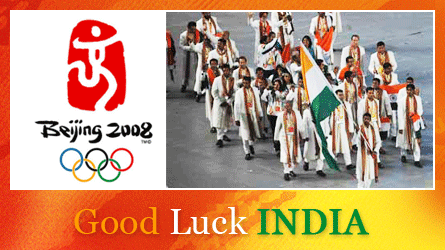
India at Beijing Olympics 2008
Some of the performers Indians could watch out for in the Beijing Olympics are :
Rajyavardhan Rathore - Shooting(Double Trap Men)
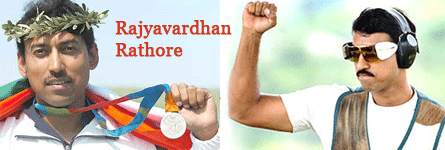
Rajyavardhan Rathore - Shooting
Anju Bobby George - Athletics (Long Jump)
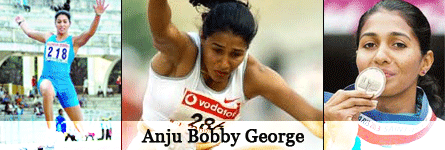
Anju Bobby George - Athletics - Long Jump
Leander Paes and Mahesh Bhupati - Tennis (Mens Doubles)
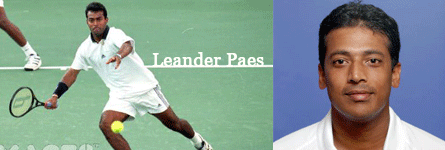
Leander Paes - Tennis
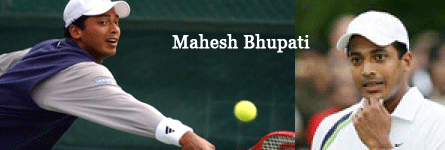
Mahesh Bhupati - Tennis
Dinesh Kumar - Boxing (-81 kg category)
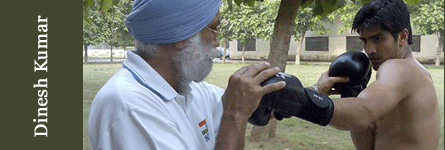
Dinesh Kumar - Boxing
Sania Mirza - Tennis (Womens Singles)
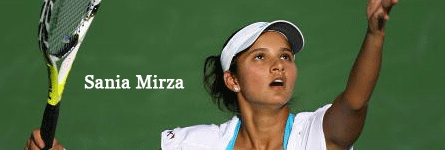
Sania Mirza - Tennis
In a country like India the adulation and following received by cricket is unparalleled as compared to other sports which are always at the periphery when it comes to following. These are the sports such as Wrestling, tennis, Archery, Athletics which are taken to in other countries compared to cricket which is played only by a handful of countries and that is one of the primary reasons for India faring badly at the Olympics. If you want a reality check try recollecting the name of an Indian athlete or an Indian boxer in the recent past who did the country proud!
The sad part is that the awareness about Olympics and debates on it come out of the closet just before and after the games. But what happens during the 4 years of recess? Athletes and sportsmen practice in anonymity, striving hard with circumstances pertaining to their sport and society while their counterparts in more glamorous games like cricket and tennis steal all the limelight. It is a struggle everyday for each of these athletes who look for support from their family, society and the government. Lack of proper training facilities, coaches, gear and equipments compounds their malady even further. But despite all these odds stacked against them they do surface in National events still trying, to get a berth in the Olympic squad and do justice to the years of toil and efforts put in anonymity.
All the efforts of these valiant athletes who overcome all sorts of odds (inferior training facilities, lack of funds, no support from the Govt.) are buried under the lack of interest of an entire nation interested only in cricket. It is heartening, however, to see the efforts of certain Organizations in promoting these neglected sports in India.
Youngistan in Olympics-Abhinav Bindra
It was the Olympian moment but with a difference for Abhinav Bindra and India.
It is common sight of an Olympian breaking into tears of joy at the medal stand. After all the occasion of scaling the ultimate height in human endeavour in any field is overpowering. And, that too when the journey happens to be long and arduous, the search for glory so ambitious and the destination so uncertain, which makes the entire enterprise extremely lonesome.
Watch Abhinav at the medal ceremony
That is why Abhinav stood out. His story goes beyond sports.
As the gold medal for rifle shooting was being bestowed on him, he stood calmly, without a trace of the exuberance that characterises such occasions. It was apparent that he meant what he said in his early comments: "I believe in myself".
At that historic moment, Bindra brought up something unique in the modern Indian discourse. He said that he just performed aggressively, without getting into agitation about the fruits of his action, as he was in the last round of the competition.
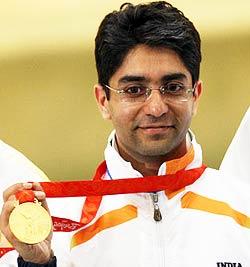 On another occasion, a long time ago, that was also precisely what was told to another legendary archer, Arjun, on a battle field in Kurushetra, not far from Bindra's farmhouse near Chandigarh.
No doubt, Bindra didn't have a saarathy [charioteer] to guide him. But his equanimity immensely helped him hit the bull's eye. In the last round, he literally came from behind and overtook China's world champion Zhu Qinan and Finland's Henri Hakkinen, who was first going into the final. The magnificent feat speaks for itself.
Bindra said he wasn't thinking of making history. He just was his usual self. His hope is that his victory will change the face of Indian sports.
There is much food for thought in what Bindra said. His victory has underscored that the best that an Indian sportsman can do is to avoid the authorities and eschew governmental patronage, which seldom comes without strings attached.
Along with Abhinav's victory India is celebrating the success of private enterprise which is thriving in India in every walk of life.
Unsurprisingly, the government officials have begun acting as if Bindra's victory is to their credit. The hard reality is yet to sink in that Bindra's achievement is almost exclusively his and his close-knit family's. His father A S Bindra, a businessman, set aside his resources for undertaking the arduous training to prepare for the Beijing [Images] Olympics [Images].
Images: Bindra wins India's first gold
His father thoughtfully converted his farmhouse into a shooting range for Abhinav.
Bindra was "cool". He reflected a self-confident generation. He represented the modern spirit of individual enterprise. Yet, he exuded the spirit of an ancient civilization which placed primacy on devotion to karma with a complete sense of fortitude. India energises itself through Abhinav Bindra's [Images] victory.
